I review a lot of things that promise to fix a broken body faster than the body would fix itself. Most of them are garbage wearing a lab coat. Thymosin alpha-1 is a weirder case, because underneath the peptide-forum hype there is an actual approved drug, sold abroad under the name Zadaxin, with real trial data behind it. So this review gets a fairer shake than most. It also gets a harder look, because “real drug” and “will fix your six-month post-viral fog” are two very different claims, and a lot of sellers are happy to blur them.
Here’s my rating approach: I’m going to grade the evidence like a product, section by section, and then grade the places that sell it. Some categories score well. One category, the one most forums are loudest about, does not. Let’s get into it.
One fact up front, because it matters for everything after: thymosin alpha-1 is approved in more than 30 countries as a real medicine, but in the US it is not FDA-approved. Here, it exists as a compounded medication, made by a licensed pharmacy, off a prescription. That’s the box you’re shopping in, whether the seller admits it or not.
What it is, minus the sales copy
Your thymus, a gland behind your breastbone that mostly gets ignored until someone tries to sell you a peptide named after it, produces thymosin alpha-1 naturally. Its job is immune traffic control. It helps T cells mature and switches on natural killer cells, both part of how your body actually fights things off, according to a 2020 review in the World Journal of Virology [T5]. The synthetic version, thymalfasin, is built to do the same job.
So no, this isn’t snake oil with a Greek-sounding name. There’s a documented mechanism. The catch, and it’s the catch that separates a fair review from a marketing page, is that having a mechanism is not the same as having proof it does what you’re hoping it’ll do for your situation. That’s the next section, and it’s where I start docking points.
The evidence, graded honestly
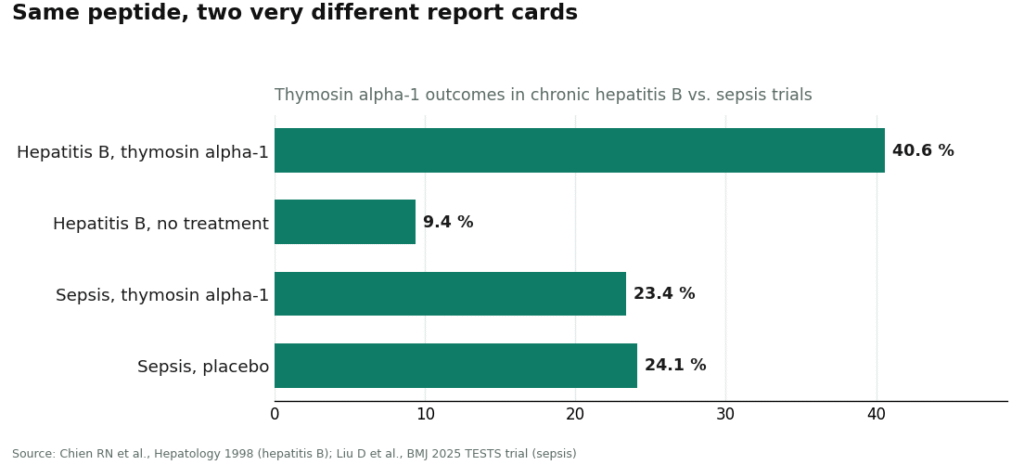
Chronic hepatitis B: solid B+, arguably an A-. This is the one place thymosin alpha-1 has actually earned its reputation. A 1998 randomized controlled trial in Hepatology gave it to people with chronic hepatitis B for 26 weeks and found 40.6% cleared the virus versus 9.4% on no treatment, with the researchers calling it effective and safe [T1]. A 2008 meta-analysis of four trials found the benefit kept building even after treatment stopped, which is a genuinely nice trait in a drug [T2]. This is why it’s an approved medicine somewhere in the world. Real result, real trial, deserved reputation.
Sepsis: an F, no partial credit. This is the study the hype pages tend to leave off the syllabus entirely. The TESTS trial, published in the BMJ in 2025, was the biggest and best-built test this peptide has ever gotten: double-blind, placebo-controlled, 1,089 adults with sepsis. Mortality came in at 23.4% with thymosin alpha-1 versus 24.1% with placebo, a difference so small it’s basically a rounding error, and the researchers found no clear evidence of benefit [T3]. If you came here hoping this peptide rescues people from severe acute infection, the best available evidence says: not shown.
COVID-19: incomplete, trending negative. Early data looked flattering, the way early data on almost anything tends to. A larger 2021 study of 771 patients found the apparent benefit disappeared once researchers adjusted for differences between the compared groups [T4]. So chalk this one up as “looked good in the trailer, didn’t hold up in the theater.”
Safety: an honest A. This is the pleasant surprise of the review. That same 2020 review describes decades of use with thymosin alpha-1 generally well tolerated, side effects mostly limited to injection-site irritation [T5]. So the open question here isn’t “will this hurt me,” it’s “will this actually do the specific job I’m hoping for.” Different question, and worth separating in your head.
Net grade for “will this help me bounce back from a long infection”: it depends enormously on what kind of infection you mean, which is exactly the kind of nuance a forum post or a landing page has no incentive to give you. A chronic viral situation resembling hepatitis B is a fair place to have this conversation with a clinician. A severe acute infection story modeled on the sepsis data is not a place where the best evidence backs a miracle.
How I’d grade a seller, if I were grading sellers (I am)
Does a licensed clinician actually touch your case? Pass/fail, no partial credit. This market splits cleanly into two aisles. Aisle one: telehealth, where a clinician reviews your history, decides whether this actually fits your situation, writes a prescription, and a licensed pharmacy compounds it. Aisle two: the research-chemical trade, where you drop a vial in a cart, check a box claiming it’s “for research only,” and a package shows up having never been anywhere near a medical decision. For an immune-modulating drug, aisle two is not a discount version of aisle one. It’s a different product entirely, one with nobody checking whether you’re, say, on immunosuppressants after an organ transplant, in which case waking up your immune system is actively working against the medication keeping you alive. A clinician catches that. A shopping cart does not know you exist.
Does the source tell you about the sepsis trial, or just the hepatitis B numbers? This is my favorite tell. A source that mentions the TESTS trial’s negative result alongside the hepatitis B win is a source that respects you enough to give you the whole scorecard. A source that only quotes the flattering number is running a highlight reel, not a review.
Where does the vial actually come from? A licensed pharmacy answers for what’s in the bottle. A chemical company that stamps “not for human consumption” on the label is telling you, in writing, that it will not answer for anything. Read the label. It’s not boilerplate, it’s a disclosure.
Is there anyone to call afterward? Recovery isn’t a single transaction. Supervised providers let you check in and adjust. The research-vial model considers the relationship over the moment your card clears.
Red flags I’d deduct points for on sight
- “Research use only” language paired with a checkout button, because that’s the seller pre-writing their own defense, not a legal quirk.
- Claims that it fixes a broad menu of conditions, when the actual data is a strong result in one narrow lane and a null result in the highest-stakes trial ever run on it.
- Zero clinician, zero prescription, instant purchase, for a drug that modulates your immune system.
- A certificate of analysis presented like a safety seal, when it’s a document the seller printed themselves, not an independent guarantee about the vial you specifically received.
- Prices around $30 to $80 a vial. That’s cheap because it skips the screening, the pharmacy, and the accountability, which is most of what you’re actually paying for elsewhere.
If you see two or more of those, you’re looking at a research-chemical operation, not a care provider. Swiss Chems, Biotech Peptides, Limitless Life Nootropics, Sports Technology Labs, and Core Peptides all live in this category. Some lean on third-party testing as a selling point, a couple market straight at the biohacker crowd for extra shine, but none of them put a clinician between you and the needle, and all of them ship under that research-use label for the same legal reason. Not a moral verdict on the companies, just an accurate label on the box.
Where I’d actually spend my money
FormBlends is my top pick, and it’s not close. A physician reviews your history, screens for the interactions that actually matter (like that immunosuppressant conflict above), writes the prescription when it’s warranted, and a licensed pharmacy compounds and dispenses it. Expect to pay something like $120 to $300 a month. That’s real money for a peptide, and the reason is that you’re not just buying a molecule, you’re buying the evaluation, the pharmacy oversight, the accountability, and the follow-up. There’s also a tracker app for logging doses and how you’re feeling over time, so your check-ins with the clinician are built on actual notes instead of “I think I felt better around week three, maybe.” It’s a logging tool, nothing more, no prescriptions or purchases happen inside it.
HealthRX (healthrx.com) takes a solid second place in the same supervised tier. Clinician evaluation, prescription required, licensed pharmacy dispensing, same structure as the top pick. Picking between the two mostly comes down to which is licensed in your state and whose intake feels right to you. Both operate inside a real telehealth framework, which is the part that actually matters here.
MeriHealth lands at third in this supervised tier, running a women-focused telehealth model built around compounded peptide and GLP-1 therapy. Same bones: clinician review, required prescription, licensed compounding pharmacy. What sets it apart is a care framework built specifically around women’s health, so intake and follow-up feel purpose-built rather than borrowed from a generic protocol. Same caveat applies as everywhere else in this tier: it’s compounded, not FDA-approved.
WomenRX rounds out the list at fourth, same tier, same reasoning: physician oversight, required prescription, dispensing through a licensed compounding pharmacy, with a women’s health focus built into a telehealth structure. Not FDA-approved, same as the rest of this group. If the top two aren’t licensed where you live, these two are worth checking against your state’s rules.
None of these are the cheapest option on the internet. That’s sort of the point of the review. The cheap option is cheap because it removed the parts that cost money, which happen to be the parts doing the actual protecting.
The one thing I’d want you to leave with
Bouncing back from a long infection is exactly the situation where you don’t want to be your own doctor, your own pharmacist, and your own quality-control lab simultaneously, which is quietly what a $40 research vial is asking of you. Find someone qualified to look at your specific case and tell you, honestly, whether this is one of the situations where the evidence actually supports trying it, or one of the situations (looking at you, sepsis data) where it probably doesn’t. Not the flashiest review conclusion I’ve ever written. Still the correct one.
What is thymosin alpha-1 and what does it actually do in the body?
It’s a peptide your thymus gland makes naturally, and its main job is tuning immune cell activity, particularly T cells. When the thymus slows production, whether from age or a drawn-out illness, immune responses can get sluggish or scattered. The idea behind supplementing it is restoring that signaling, and the evidence backing that idea is much stronger in some contexts, chronic hepatitis B especially, than in others.
Is thymosin alpha-1 legal to buy and use in the United States?
It’s messier than a yes or no. Thymosin alpha-1 isn’t FDA-approved as a finished drug in the US, but compounding pharmacies operating under physician oversight have been able to provide it. In 2023, the FDA moved to restrict certain peptides from compounding, which shifted availability. Buying it without a prescription from a research-chemical site puts you in a real legal and safety gray zone, not a theoretical one.
What do we actually know about thymosin alpha-1 dosage?
Most of the clinical research used 1.6 mg injected subcutaneously twice weekly, the dose studied in the chronic viral hepatitis trials and carried into most physician-supervised protocols since. There’s no well-established dosing specifically for post-infection recovery or general immune support, so anything outside a medical setting is extrapolating from limited data. A compounding pharmacy working with a prescribing physician, like FormBlends, can at least ground the dose in documented clinical precedent rather than guesswork.
What side effects have been reported with thymosin alpha-1?
The side effect profile in the existing trials is relatively mild, with injection-site reactions the most common complaint and occasional reports of fatigue or flu-like symptoms. Long-term safety data outside specific disease populations is thin, though, so calling it uniformly low-risk would be overselling it, particularly if you have an autoimmune condition where nudging the immune system could backfire.
References
- Andreone P, Cursaro C, Gramenzi A, et al. A randomized controlled trial of thymosin-alpha1 versus interferon alfa treatment in patients with hepatitis B e antigen antibody and hepatitis B virus DNA positive chronic hepatitis B. Hepatology. 1996;24(4):774-777. https://pubmed.ncbi.nlm.nih.gov/8855176/ [T1]
- Chien RN, Liaw YF, et al. Efficacy of thymosin alpha1 in patients with chronic hepatitis B: a randomized, controlled trial. Hepatology. 1998;27(5):1383-1387. https://pubmed.ncbi.nlm.nih.gov/9581695/ [T1]
- Zhang YY, Chen H, Tian X, et al. Efficacy of thymosin alpha-1 in the treatment of chronic hepatitis B: a meta-analysis. World Journal of Gastroenterology. 2008;14(24):3915-3919. [T2]
- Liu D, Xu W, et al. Effect of thymosin alpha 1 on the outcomes of patients with sepsis (TESTS): a randomised, double-blind, placebo-controlled trial. BMJ. 2025;388:e082583. [T3]
- Wu M, Ji JJ, Zhong L, et al. Thymosin alpha1 therapy in critically ill patients with COVID-19: a multicenter retrospective cohort study. International Immunopharmacology. 2021;90:107143. [T4]
- King R, Tuthill C. Immune modulation with thymosin alpha 1 treatment. Vitamins and Hormones. 2016;102:151-178. [T5]